California has made important strides in direction of decreasing air pollution from autos by adopting trailblazing policies to speed up the adoption of each passenger and heavy-duty zero-emissions autos. The state is constant this momentum by creating an bold regulation to require the state’s largest medium- and heavy-duty (MHD) industrial fleets to start transitioning to electrical vehicles in 2024, finally requiring one hundred pc of MHD autos bought by massive industrial and public fleets that function within the state to be zero-emissions in 2042. This new regulation would apply to supply vans, large rigs, field vehicles, and buses.
The Advanced Clean Fleets (ACF) rule has the potential to considerably scale back climate-warming greenhouse gasoline (GHG) emissions in addition to dangerous air pollution like effective particulates (PM2.5) and nitrogen oxides (NOx) from the quite a few industrial and authorities fleets of MHD autos within the state. California’s Advanced Clean Trucks (ACT) rule handed in 2020, which required producers to promote an rising proportion of zero-emissions MHD autos, was a superb begin. Now, the proposed ACF goes a step additional, and would require fleets to buy zero-emission autos. The California Air Assets Board (CARB) estimates it will improve the variety of clear vehicles and buses on California’s roads and highways by 60 % in 2035 and practically 70 % in 2050 in comparison with the ACT.

Medium- and heavy-duty autos (like supply vans, tractor vehicles, field vehicles, and constitution buses) are liable for an outsized quantity of air pollution – though simply 7 percent of vehicles within the state, they emit greater than one-quarter of GHG emissions, greater than 60 % of smog-forming NOx air pollution, and greater than 55 % of lung- and heart-harming PM2.5 air pollution from California autos.
The ACF consists of 4 major pillars, specializing in state and native public company fleets, massive industrial and federal fleets, drayage operations, and a continuation of the ACT rule requiring one hundred pc zero-emissions truck gross sales by 2040. In a previous blog, I went into extra element on the parts of the rule as proposed by CARB.
On this entry, I suggest two key modifications CARB might make to supercharge the effectiveness of the ACF and create helpful, short-term outcomes for freight-adjacent communities, locations which were traditionally and disproportionately impacted by air air pollution.
Regulate extra tractor vehicles, together with the smaller fleets
Among the many tens of millions of autos on California roads and highways, tractor vehicles (large rigs, 18-wheelers, semis, lorries, or no matter you wish to name them) represent a mere 1 %. Nevertheless, this comparatively small group of huge autos on our roads is liable for a disparate 13 % of GHGs, 25 % of PM2.5, and 33 % of NOx emissions from all on-road transportation within the state. These vehicles commonly function alongside industrial corridors – areas that usually flank communities disproportionately impacted by air air pollution.
The ACF is a chance to ship significant reductions in air air pollution for essentially the most affected communities, however the present proposal falls brief of what’s technologically and economically possible.
In its present type, the rule would require fleets with 50 or extra lined MHD autos or $50 million in annual income to conform. Nevertheless, the composition of a industrial fleet is extra necessary than its dimension in lots of circumstances, given {that a} fleet of 10 tractor vehicles might emit extra air pollution than a fleet of fifty supply vans relying on each day mileage, gas kind, and different components. So, whereas a numeric threshold of fifty might look good on paper (everybody like an simply divisible quantity), the rationale round setting this crucial piece of the regulation must be data-driven and centered on desired outcomes.
This compliance threshold is among the most pivotal components of the regulation and it must be primarily based on well-researched and examined desired outcomes – e.g. if we wish X quantity of emission reductions, we should always regulate fleets of Y dimension and better.
In step with this, I made a decision to run the numbers myself utilizing an enormous dataset that represented all tractor vehicles working in California (it practically broke my pc!).
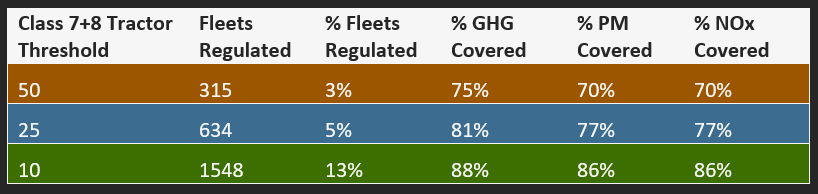
The outcomes had been equally fascinating and enlightening. I discovered that a numeric compliance threshold of 10 is the candy spot for capturing practically all tractor emissions below the rule whereas avoiding a major improve within the variety of regulated small companies and company workload.
At a numeric threshold of fifty, solely 3 % of California tractor truck fleets could be lined below the ACF. Nevertheless, decreasing the edge to 10 might ship round 15 % better GHG, PM2.5, and NOx emissions reductions from tractor vehicles whereas nonetheless solely regulating round 13 % of California tractor fleets. Due to their outsized contributions to air air pollution within the state, a 15 % improve in emissions reductions is critical and value pursuing.
In California, practically 90 % of tractor vehicles on the highway belong to about 15 % of business fleets. These fleets, these with greater than 10 tractor vehicles, are liable for the lion’s share of emissions: about 85 % of effective particulate and ozone-forming nitrogen oxide emissions and just below 90 % of greenhouse gasoline emissions from all California tractors (see the pie charts under).
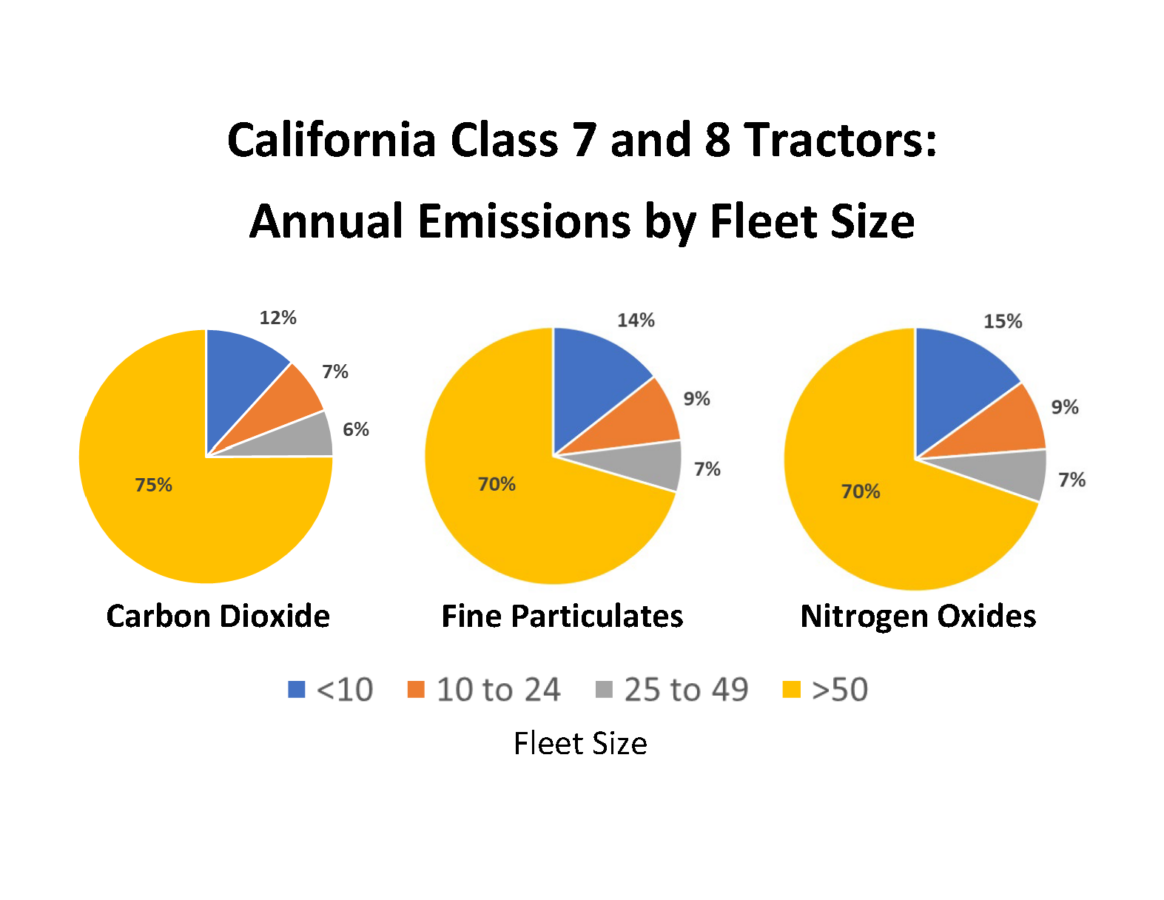
A decrease threshold would deliver extra reductions in air air pollution sooner for the communities who want it most. Whereas this, together with local weather change mitigation, must be the first focus of the rule, the ACF must also be tailor-made to keep away from impacts on small companies. A compliance threshold of 10 for tractors is an efficient stability as a result of it captures nearly all of emissions however avoids regulating the smallest, and most economically weak, tractor fleets.
This has two positives. First, laws must be tailor-made equitably to keep away from impacting weak enterprise house owners at any time when potential. Different programs can be found to help the mom-and-pop fleets in electrification. Second is a lesson I discovered whereas working in state authorities: sometimes, the smallest emitters require essentially the most consideration from company employees as a result of these small companies usually shouldn’t have the capability to make use of employees internally with experience in regulatory compliance. Which means businesses can spend essentially the most time on the least consequential emitters (particularly in emissions reporting applications).
Transfer up the goal date by 4 years
The present draft of the rule features a requirement for one hundred pc zero-emissions truck gross sales by 2040, however our analysis reveals that well being, environmental, and financial advantages may very well be considerably elevated by shifting the date up 4 years to 2036. Not solely do the local weather and air high quality crises demand that we electrify as quick as potential, however a sooner date additionally units a transparent market sign that California is critical about environmental justice and addressing local weather change. This can affect accelerated growth and buildout of charging infrastructure for MHD autos in addition to reductions in manufacturing prices for autos by means of economies of scale. Furthermore, CARB’s own research reveals that that is each economically and technologically possible.
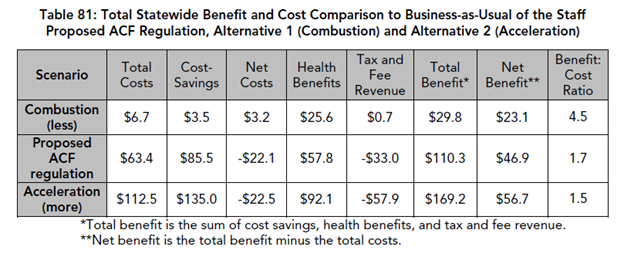
Transferring the requirement for one hundred pc zero-emissions HDV gross sales as much as 2036 from 2040 would end in greater than 130,000 further electrical vehicles on the highway in 2050, based on analysis recently contracted by the Union of Involved Scientists (UCS) and the Pure Assets Protection Council. These further clear vehicles are estimated to have an effect on a rise in web societal advantages of practically $10 billion in comparison with the present ACF proposal.
Changing soiled vehicles with zero-tailpipe emissions autos is essential to enhancing air high quality and our research estimated that shifting up the one hundred pc gross sales date by simply 4 years would improve the variety of averted untimely deaths, averted hospital visits, and different associated sicknesses by about 10 % by means of 2050. This represents practically $3 billion in further cumulative well being advantages.
Elevated environmental advantages from extra stringent laws can usually include further prices for regulated industries. Nevertheless, the ACF and automobile electrification are a win-win for the setting, human well being, and trade. Along with important will increase in monetized well being advantages, a sooner one hundred pc zero-emissions gross sales date would deliver further price financial savings to California truck fleets, principally by means of elevated gas and upkeep financial savings. In comparison with the proposal, the one hundred pc by 2036 possibility is estimated to extend cumulative fleet financial savings by $300 million, roughly 14 %. By all important measures we’ve analyzed, the {dollars} make sense for an accelerated one hundred pc zero-emissions timeline.
Industry groups, environmental advocates, internationally-lauded research organizations, and CARB have all independently revealed analysis exhibiting that electrical vehicles will attain price parity with their combustion counterparts round 2030, pushed largely by the quickly declining price of batteries. A 100-percent zero-emissions gross sales date of 2036 lags between 10 and 22 years behind these research’ estimates for price parity between MHD EVs and combustion fashions, relying on the automobile.
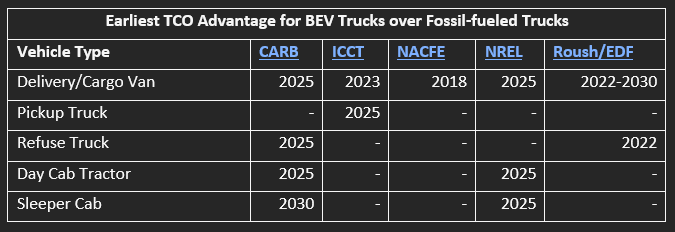
If a non-emitting possibility is each accessible and less expensive to personal and function over its lifetime, why then would we enable its polluting equal to be bought? I might argue that the date of the one hundred pc zero-emissions gross sales requirement must be largely influenced by this query.
What’s holding the regulators again?
So why hasn’t CARB thought of these enhancements if they supply the advantages I’ve outlined? In brief, they’ve. Each a diminished threshold and a sooner timeline for zero-emissions truck gross sales and fleet electrification had been thought of below an “Accelerated Different” in CARB’s Initial Statement of Reasons (ISOR), which examines the prices and advantages of various regulatory choices. Whereas employees have labored exhausting and in good religion on this rule, our deep dive into the info and associated analyses present we are able to go additional than the proposed rule.
The ISOR talked about a number of the reason why these choices couldn’t be pursued, together with feasibility for fleets whereas the market continues to be creating, the rise in regulated fleets, impacts to small companies which will have entry to much less capital, and points associated to the fee and timeline of charging infrastructure buildout within the early years of this system. Every of those issues, though reliable, is anticipated to be addressed because the market continues to increase quickly, with the assistance of provisions within the Inflation Reduction Act and Infrastructure Funding and Jobs Act that help zero-emission autos, ongoing funding from state company applications and, additionally, by tailoring the ACF to keep away from impacting the smallest companies.
With nicely over 100 fashions of zero-emissions MHD autos accessible at the moment, the marketplace for clear vehicles and buses is increasing and anticipated to speed up. CARB’s analysis of battery prices within the ACF ISOR reveals quickly declining prices for MHD automobile batteries, with smaller vehicles lagging behind passenger automobiles by simply two years and bigger vehicles by 5 years (See Determine 10 within the above hyperlink). By this measure, battery prices for the biggest vehicles, like sleeper cab tractor vehicles, might be below $100/kWh across the time the proposed language would deliver sleeper cabs into this system in 2030. A decrease compliance threshold for these bigger vehicles might expedite the decline of battery prices by pushing R&D and improvements in addition to by means of economies of scale as manufacturing ramps as much as meet demand. Whereas it’s true that EV battery costs have increased this yr in comparison with final yr regardless of elevated manufacturing, battery costs are anticipated to fall to $100/kWh by 2024.
CARB employees makes a very good and important level that smaller companies usually shouldn’t have entry to capital as readily as massive companies, nevertheless, a decrease compliance threshold just for tractors would keep away from regulating smaller fleets with fewer assets. These companies wouldn’t have to start compliance below the regulation till 2027 or 2030, relying on the kind of tractor, which permits half a decade to plan. Moreover, the not too long ago handed Inflation Discount Act establishes a tax credit score of as much as $40,000 for the acquisition of bigger zero-emissions industrial vehicles by means of 2032. CARB employees estimates the price of a brand new battery-electric Class 8 Day Cab tractor to be $176,000 in 2030, whereas the identical mannequin with a diesel motor to be round $150,000. With the federal tax credit score, fleets might buy the electrical model of this truck for a similar value because the diesel and start saving considerably on gas and upkeep on day one.
Whereas there are only a few publicly accessible quick charging stations for heavy-duty vehicles at the moment and CARB employees are appropriate to boost this situation, most MHD ZEVs return to their house bases every evening—particularly supply vans and day cab tractor vehicles—and are anticipated to cost at these depots. Companies can begin planning for the event of charging on their very own properties whereas the public-facing infrastructure develops. Already, expertise for MHD charging is advancing and a fast-charging normal to quickly cost large rig-sized batteries, referred to as the Megawatt Charging System, is anticipated to be finalized in 2024.
Public charging is probably going for use extra by long-haul tractors, which might not be regulated below the rule till 2030 below the present proposal. The buildout of public MHD charging will definitely be a momentous job and require some grid upgrades, however it will possibly and might be accomplished. Each authorities and the personal sector are planning for MHD charging infrastructure. Car producers are additionally entering into the infrastructure sport. Volvo, for instance, plans to have a California corridor of high-powered chargers on-line by the top of 2023. Daimler, together with NextEra Power Assets and BlackRock Renewable Energy, plans to start development of a nationwide charging system for long-haul tractor vehicles in 2023.
California’s Power Fee dedicated over $300 million in investments towards MHD charging infrastructure for the 2022-23 fiscal yr and much more funding is slated for the approaching years. This funding helps a number of applications, together with EnergIIZE, which affords quite a few funding alternatives for the event of MHD charging infrastructure. EnergIIZE features a funding class for MHD public charging, providing as much as $500,000 in incentives per challenge. One other funding category in this system affords as much as three-quarters of one million {dollars} for the planning and growth of depot charging infrastructure initiatives.
Along with state help, the federal government is supporting electrical automobile charging infrastructure deployment by means of the Inflation Discount Act and Infrastructure Funding and Jobs Act, and utilities are starting to step as much as the position they’ll play in help of increasing MHD charging. A gaggle of huge West Coast utilities came together in 2020 to collaborate and research the problem and located that simply 27 websites throughout the Interstate 5 Hall might serve anticipated demand in 2030, the primary compliance yr for long-haul tractors below the proposed ACF.
The proposed ACF rule is excellent, and may very well be higher
Whereas the draft ACF CARB employees have proposed will create important reductions in climate-warming GHG and air high quality emissions, if the rule centered extra on tractor vehicles and accelerating the requirement for one hundred pc zero-emissions gross sales, then it will ship sooner and extra significant advantages with out considerably rising regulatory burdens on affected companies or significantly increasing administrative work for CARB employees.
Because it stands the ACF is definitely an bold regulation, but it’s potential to strengthen the proposal given present expertise, constructive economics, and creating infrastructure. Most of all, it’s needed given the local weather disaster and inequitable entry to scrub and wholesome air.
UCS is working intently with our allied accomplice organizations to push for essentially the most bold and protecting rule possible. Adopting a powerful ACF will assist to speed up the market and applied sciences for zero-emissions MHD autos not simply in California, however throughout the nation. The earlier we attain price parity, the earlier we are able to considerably scale back emissions from freight and items motion.
from Lifetime Savings SP – My Blog https://ift.tt/7fwOX0q
via IFTTT